Here is a link to some marevelous rare footage of the aftermath of the earthquake and fire.
https://www.youtube.com/watch?v=Tm9kqImgsxQ
Showing posts with label earthquake. Show all posts
Showing posts with label earthquake. Show all posts
Friday, April 18, 2014

THE BEAUTIFUL CALL BUILDING
THE BEAUTIFUL, ICONIC CALL BUILDING at Third and Market Streets on fire. The photos were taken just minutes apart. The Cal building actually ignited from the heat rather than from the actual flames. It literally smoldered for a few minutes and then burst into flames. At the bottom center of the first photograph you can just make out the tip of Lotta's Fountain, site of today's celebration.


THE FIRE ON MARKET STREET
The fire from Market Street from about Powell and Market, where the cable car turn-around and Bloomingdale's are now located.


APRIL 18, 2014, 5:12 am
AT THIS VERY MOMENT, AS I SIT AND WRITE, 108 years ago the earth beneath San Francisco shook with a ferocity that no living person could recall ever occurring before. The earthquake was not "great" by recent standards, 7.8 on the Richter Scale but in a city that knew nothing of seismic engineering standards, built on hills, and sand, and fill, it was devastating. A strong foreshock preceded the main shock by about 20 to 25 seconds. The strong shaking of the main shock lasted about 42 seconds. Within a short while, fires began, which joined together and became unstoppable until they reached Van Ness Avenue some days later, leaving San Francisco a pile of ashes and rubble. 3,000 people died.
At this very moment, a gathering is taking place at Lotta's Fountain, at the corners of Geary Street, Kearny, and Market Streets. It's an annual affair since 1907. In 1906, it was the place where people gathered together for news and to get water - fed by one of the few water mains that had not ruptured.
It used to be that survivors of the quake would gather there in memorial for the dead and in celebration for the people and the city that survived and rose from the ashes. Now there are but two survivors remaining, too old to make the journey to the fountain, but San Francisco remembers that day, almost as if it were yesterday, and celebrates them and the City by the Bay.


At this very moment, a gathering is taking place at Lotta's Fountain, at the corners of Geary Street, Kearny, and Market Streets. It's an annual affair since 1907. In 1906, it was the place where people gathered together for news and to get water - fed by one of the few water mains that had not ruptured.
It used to be that survivors of the quake would gather there in memorial for the dead and in celebration for the people and the city that survived and rose from the ashes. Now there are but two survivors remaining, too old to make the journey to the fountain, but San Francisco remembers that day, almost as if it were yesterday, and celebrates them and the City by the Bay.
Thursday, April 17, 2014
MARKET STREET AND THE CALL BUILDING
A very rare color photograph of Market Street and the Call Building shortly before the Great Earthquake and Fire.

Thursday, February 20, 2014
TSUNEKICHI IMAI AND THE STORM: THE BOY WHO MADE AN ICON

What is regarded as a San Francisco
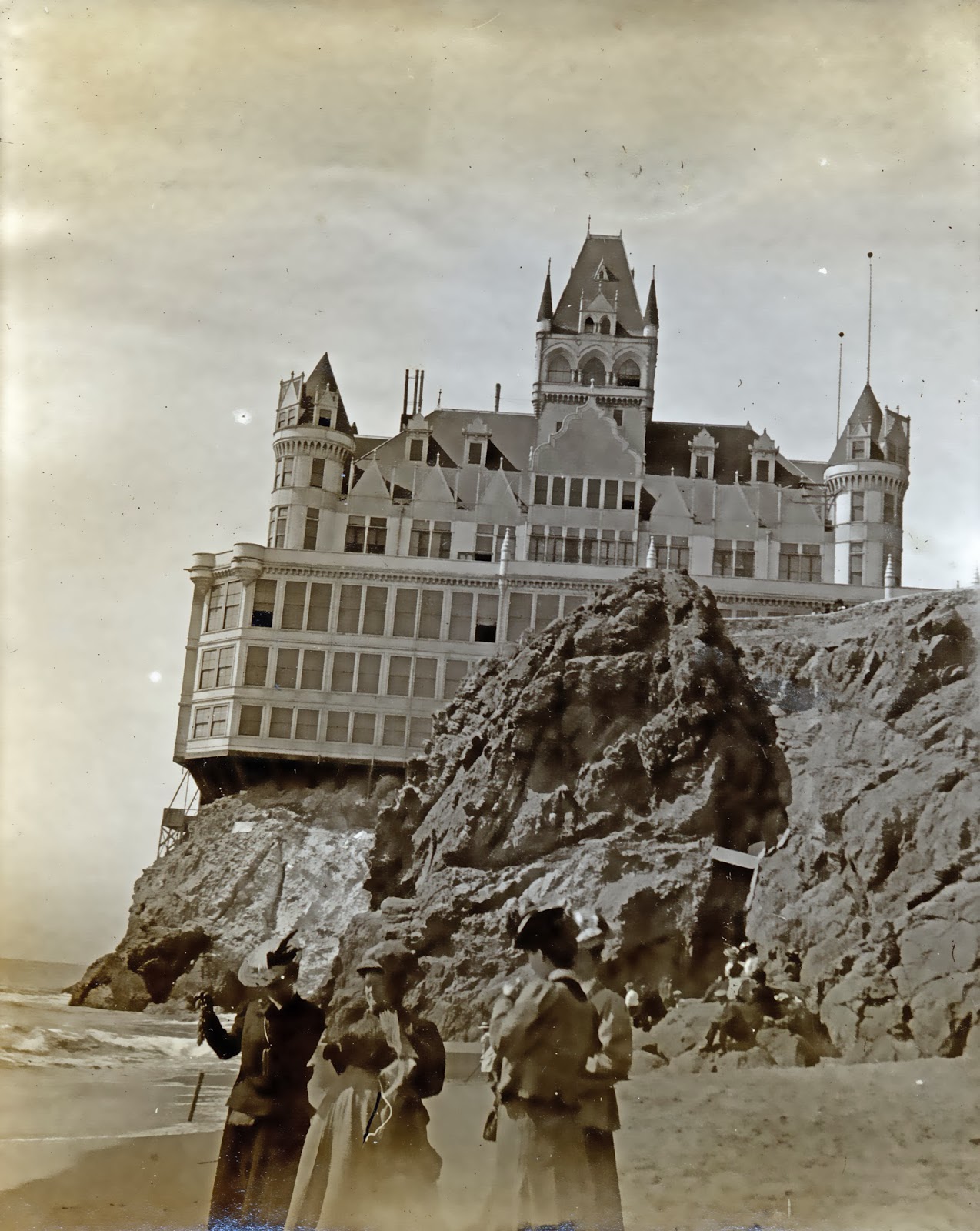
icon, a dramatic photograph of the third of the San Francisco Cliff Houses
(1896 – 1907), backlight by an approaching, intense thunderstorm, is etched in
the minds of San Franciscans. If you have been to San Francisco it is likely
that you have seen it. If you have been to the Cliff House, particularly before
its recent remodeling, that you saw it is almost certain — what has easily
become one of the city’s most reproduced and most famous photographs. And it
was taken by a boy — a Japanese boy named Tsunekichi Imai. Well, he really
wasn’t a boy, but a young man of thirty, although he was touted as such I it
made for a better story.
Tsunekichi was born in 1872 in Yamaguchi
Prefecture, Japan, an agricultural area of Honshū, where he studied photography
as well as the more traditional arts of ikebana (Japanese flower arranging) and
Bonsai. When word of the Chinese Exclusion act of 1882 reached Japan, hundreds
of Japanese emigrated to California in the hopes of finding work; replacing cheap
Chinese labor which had been cut off. In 1889, with his wife Taki and an infant
daughter, he joined the exodus and moved to the flourishing Japanese community
in San Francisco.

Tsunekichi Imai
It had been Imai’s plan to work, live
frugally, save money, and then return to Japan. Be that as it may, things did
not work out that way. Tsunekichi and Taki’s family continued to grow; and as
it grew, Japan and the prospects of returning home, grew more and more distant.
All in all, they had seven girls and one boy, Ted (the first male child born in
the United States); however, one girl died at age seven from appendicitis.
The
young man opened a photographic studio at 1303 Polk Street, near the corner of Bush
Street, a site now occupied by a Moroccan restaurant. He was in his shop
working early in the morning of April 18, 1906, at 5:12 a.m. to be exact, when
the earth shook and later the sky of San Francisco burned. In later years, Imai
would take some delight in telling his family, especially younger folk, how the
walls of his shop shook and things in the store fell to the floor. As in many
cases of the Great Earthquake and Fire, it was not the quake itself that
necessarily did the most damage; but rather the fires the followed and engulfed
much of the city. For example, Old St. Mary’s on California Street and nearby
Grace Cathedral showed few signs of damage that day, only to be destroyed by
flames soon after the quake.
Imai, dedicated to his craft, took some
of his equipment and headed out onto the streets of the city to see what had
happened and to record what he had seen. According to his son Ted, who passed
away in 2007 (and who interestingly is sometimes credited with the most
recognizable photograph of the Cliff House ever rather than his father) the
most dramatic picture taken at the time by Mr Imai was of a man standing on the
upper balcony of a burning building, pleading for help as he himself caught
fire. Tsunekichi took the photograph just as soldiers on the ground shot the
man in order to put an end to his agony. Worried about the legal implications
of that photograph, Imai eventually destroyed it.
When he at last returned to his shop,
fires which had started in the vicinity of Davis and Market Streets and
Davis/Drumm Streets and Clay, had moved westward and combined with fires which
had ignited at Leavenworth and Pacific and Polk Street near Pine. A desperate
battle ensued between man and flames. In order to stop the fire from spreading
even further west, a firebreak was created by dynamiting a strip of buildings, running north and south between Van
Ness Avenue and Polk Street. So fast was the demolition that Imai had no chance
to rescue things from his studio — he was certain all was lost. But then one of
his neighbors, whom he happened to meet, suggested that he go to Lafayette
Park, at Washington and Laguna Streets, where people from the neighborhood were
taking shelter. He did, and was amazed to find that firemen and volunteers had
taken it upon themselves to salvage what they could from his neighborhood, move
them to Lafayette
Park, and
cover them
in tarps. Indeed, he was amazed to find most of the things from his shop piled
together and labeled with his name.

Watching the fire from Lafayette Park.
When things had settled down, and the
city began to rebuild itself, Imai and his family moved to 1950 Bush Street which
remained the family home for many years thereafter. Imai died on January 24,
1929 and thus did not see the tragedy which struck the family later on in 1942
when the entire family, including his wife Taki, were imprisoned at Camp Topaz
near Delta, Utah for the duration of World War II. Sadly the family was only
allowed to take with them what they could carry: and thus, lost almost
everything, including their home and a wealth of work by Tsunekichi.
Another photograph of the Cliff House by Tsunekichi Imai
As
to the photograph of the “Gingerbread Cliff House” there is some controversy in
the matter. According to Ted Imai, the photograph, originally titled “Nighttime
Cloud Effect” was a fake; in that it was ostensibly created in Imai’s studio.
Ted had not been born yet but is quoted as saying that his father, over the
years, told him that he had shot the photo in broad daylight and then had
gradually darkened it over a period of some four or five days; retouching it as
he went along until the desired effect was achieved. Ted claimed that the
picture as we see it would have been impossible to take given the state of
cameras, which relied on flash powder for supplemental illumination, during
that period. Be that as it may, Tsunekichi was well known as a practical joker:
something which must also be taken into account.
Other photographers, some with some
skill in night and weather photography, have categorically stated that the photograph
is real. There is no lightning in the photo (as some people see and claim). With
regard to the the streak of light toward the upper left, the so-called “silver
lining effect,” one can see the shadow of that cloud to its right, cast on
another cloud. Experts say that no one would produce that shadow effect in a
studio, since it was of little interest. Others have pointed out that the
relative calmness of the seas in the cove below the Cliff House, is indicative
of a timed exposure of several seconds. One might suppose nevertheless, that given
the enjoyment that the photograph has provided people (a large reproduction of
the photograph hung in my dining room for years) that it really doesn’t matter
at all.

A restored version of "The Storm."
Subscribe to:
Posts (Atom)